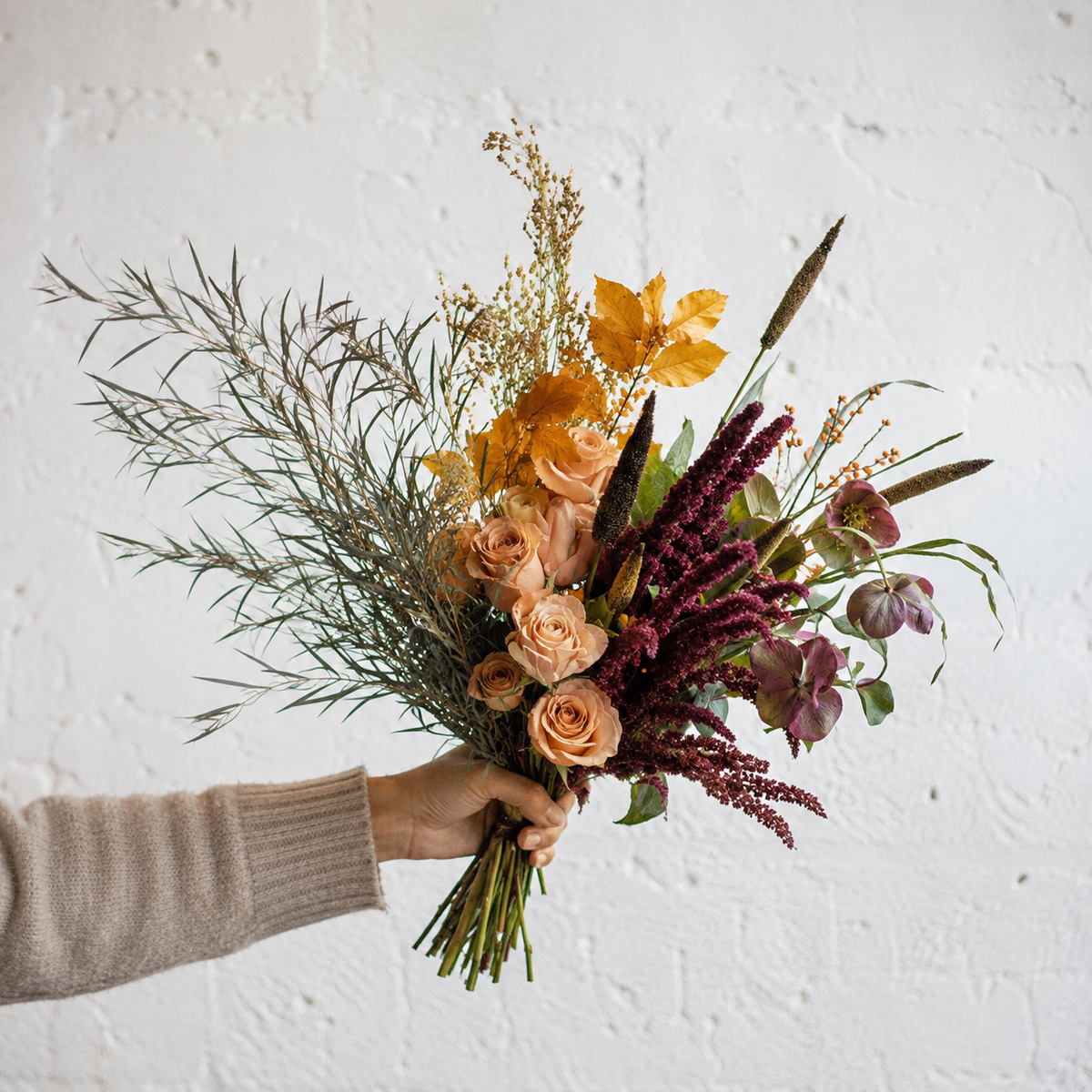
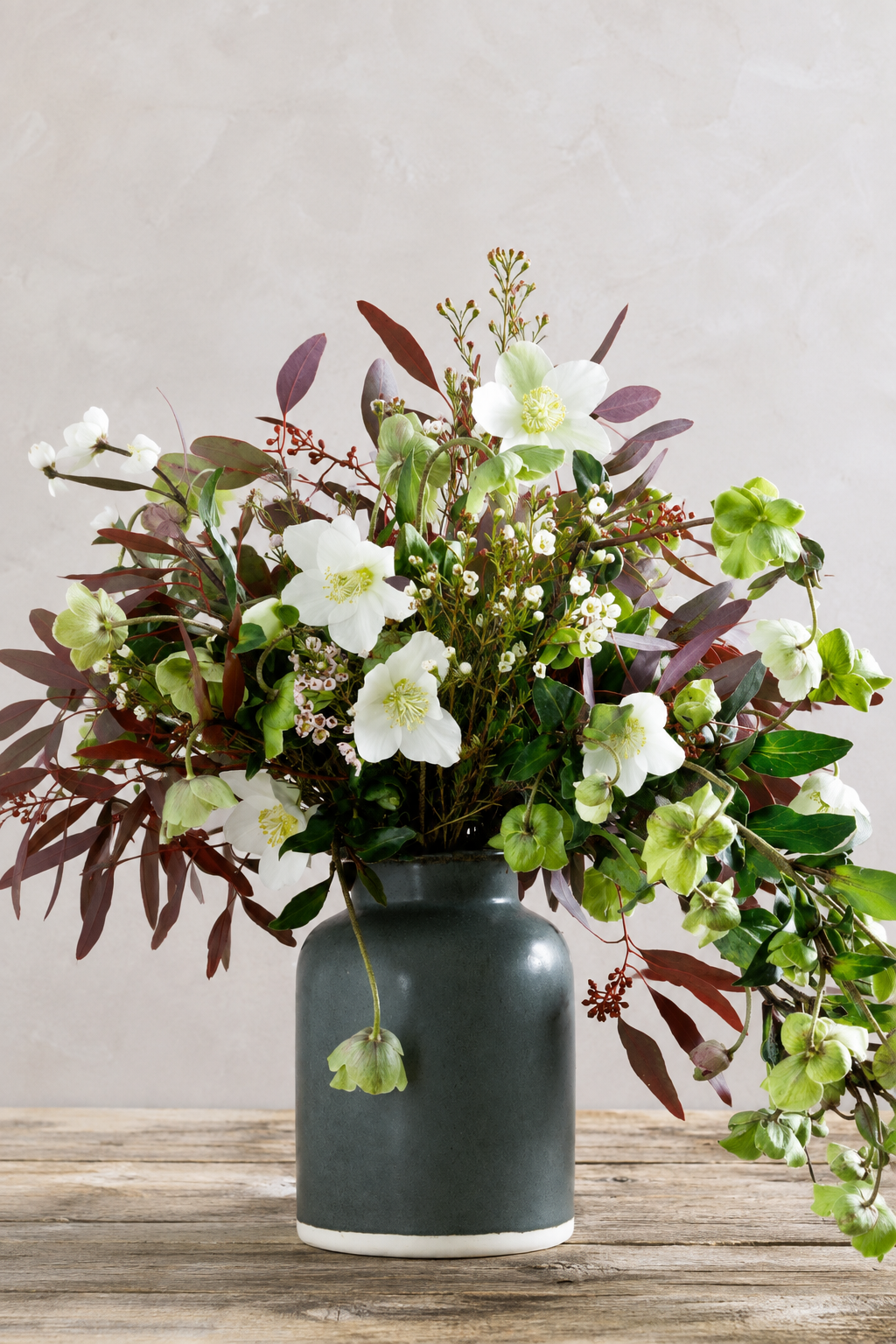
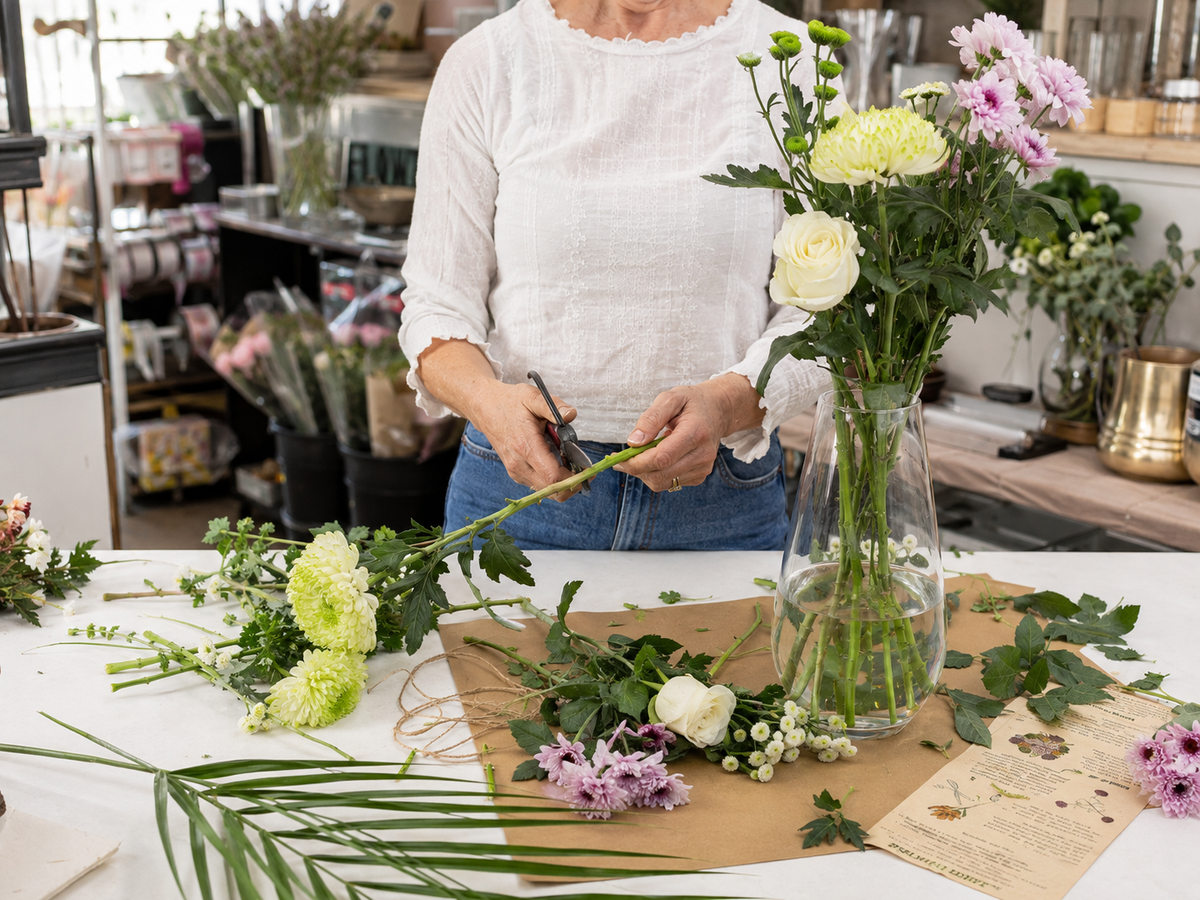
A harmonious garden bouquet begins not with the search for a perfect list of flowers, but with a quiet look at what genuinely looks good that day. After a cold night, that might be flowers still holding their colour, firm branches, supple grasses or dried seed heads. Choose only known, undamaged material from your own garden, or material you have clear permission to cut. Then sort it by its visual job: focal point, support, structure or line. This simple method remains flexible even when there is little to gather and the season is setting the terms.
You need neither something from every variety nor a set number of ingredients. A single branch can provide both structure and line; a small group of flowers can bring colour and repetition. What matters is that the chosen elements work together rather than all competing for attention at once.
Look first, then choose
Do not head straight through the beds with the secateurs. First look at colour, surface, firmness and growth habit. Which flowers look fresh and undamaged? Which leaves offer a calm plane? Where does a stem, panicle or branch draw an interesting line? This gives you a rough idea of what the bouquet will need before you make a cut.
After cold nights in particular, actual condition matters more than the name of a plant. Tolerance of frost and cold varies according to the plant, its stage of development and the conditions. Material that is still upright is therefore not automatically suitable. Leave soft, badly damaged or unattractive sections where they are, and plan only with what genuinely looks intact that day.
Cut cleanly and put the stems into water promptly
For known garden material, the basic approach is simple: use clean, sharp tools and, if practical, cut during a cooler part of the day. Put the stems into clean water as soon as you can afterwards. Before arranging, remove any leaves that would sit below the waterline.
These steps are general preparation, not a rule for every individual plant. Some species need particular treatment, so known species-specific guidance always takes precedence. For choosing the material itself, the starting point is simply to work cleanly and not leave the cut material lying around dry.
Four visual roles instead of a rigid ingredients list
Lay the cut stems side by side or stand them loosely in separate containers. You can now try assigning roles to them. These roles are a way of seeing, not a rule and certainly not a quantity guide.
- Focal point: The material that catches the eye first. It might be a bold flower, but it could just as easily be a distinctive shape or an unusual block of colour.
- Support: Smaller or quieter elements that repeat a colour, curve or movement and create transitions.
- Foliage and structure: Leaves, sturdy stems or branching forms that give looser material visual support and a little weight.
- Line and air: Grasses, fine branches, panicles or seed heads that reach beyond the more compact forms and leave the spaces between them visible.
One element can take on several roles. A branching seed head can guide the eye, create visual breadth and at the same time bring air between larger flowers. If one role is not represented at all, that does not necessarily make the bouquet incomplete. Ask instead whether it genuinely lacks anything.
Bring order to the colour without polishing away the garden
With very mixed material, a limited colour idea often helps. You might let one colour dominate and repeat a second only in small touches, or bring together several shades from a similar colour family. This is an option, not a rule. Repetition is what matters: if a colour or shape reappears in several places, the selection feels cohesive more readily.
Different heights create order too. Let some lines extend beyond the denser forms and keep others lower. Leave space between them. A bouquet does not automatically become more harmonious when every gap is filled and the top of every stem is brought to the same level. With garden material, those small variations are often what give it character.
When grasses, seed heads and branches become more important
As the season advances, flowers may become scarcer, while grasses, fruiting stems and seed heads, foliage or branches carry more of the composition. Their strength lies in qualities of their own: a curved line, a matt surface, airy volume or a clear silhouette.
A fine branch can open up the outer outline, a dense seed head support a quiet centre, and a grass shift the direction of the eye. Use such forms only when they are in good condition on that particular day. What was firm yesterday can look different after a change in the weather. Reassess late-season garden material on the day you cut it.
Refine the selection step by step
- Begin with the material that carries the colour or form idea most clearly.
- Add a quieter companion that repeats at least one visible quality.
- Add foliage or branching forms if the selection lacks visual support.
- Add line and airy texture where the silhouette still feels compact or static.
- Take a step back. Remove something if it is only taking up space and has no clear job.
This order describes selection and visual composition, not a tying technique. You can use it just as well if everything will later be placed loosely in a vase. The key moment is the brief pause before adding one last thing: often it is not another stem that is missing, but a little space.
The practical final check
- Do you know every material you have used, is it intact, and does it come from your own garden or somewhere you clearly have permission to cut?
- Were clean, sharp tools used and the stems put into clean water promptly?
- Have the leaves that would sit below the waterline been removed?
- Is there a clear focal point or a recognisable main direction?
- Do colour, shape or movement repeat in more than one place?
- Do the heights vary without finer lines obscuring the rest?
- Do visible gaps remain in which the individual forms can work?
- Has late-season or cold-stressed material been judged by its current condition?
The garden rarely provides a complete ingredients list. That is precisely its charm: a personal bouquet need neither imitate nor replace professional floristry. It can show the exact moment in the season through a considered selection, recurring colours and forms, and enough calm between the stems.